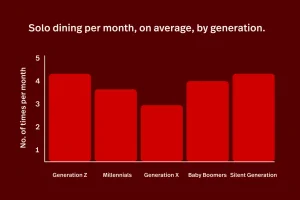
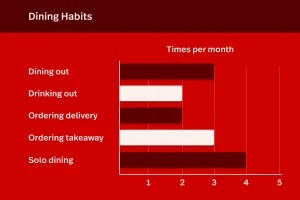
According to the Lightspeed State of the Hospitality Industry Report 2026, Australians dine alone an average of four times per month, spending around $62 in the process. More remarkably, it’s the only hospitality behaviour that remains broadly consistent across every generation. While dining out, drinking out, takeaway and delivery all taper with age, solo dining quietly refuses to follow the same pattern.
It’s an odd result.
Spend a few minutes with the report and a familiar pattern emerges.
Across almost every behaviour, Generation Z leads the way, Millennials follow close behind, and participation gradually softens through Generation X, Baby Boomers and the Silent Generation. It’s exactly what you’d expect. Life changes. Priorities shift. Free time becomes harder to come by, then eventually easier again.
And then there’s the table for one.
Generation Z and the Silent Generation—two groups separated by almost seventy years—choose to dine alone at almost exactly the same rate. It’s the only behaviour in the report that refuses to sort itself by age.
That raises a much more interesting question of why eating alone has become one of the few hospitality experiences that seems to resonate with almost everyone.
Want to know what Australian diners will be asking for next?
Explore the data behind the trends, preferences and behaviours shaping hospitality in 2026. Download the State of the Hospitality Industry Report for free today.
Why doesn’t solo dining follow the same generational pattern?
Solo dining isn’t booming or declining. According to the Lightspeed State of the Hospitality Industry Report 2026, it has become a remarkably consistent part of Australian dining behaviour across every generation.
That’s what makes this data so fascinating.
If solo dining were driven by one generation, we’d probably explain it away. We’d say Gen Z had embraced independence, or that retirees were simply taking advantage of having more spare time to enjoy leisurely lunches. It would be filed away as another demographic quirk and we’d move on.
But these numbers refuse to cooperate. Every generation appears to have arrived at the same conclusion and that conclusion is sometimes it’s nice to eat by yourself, which we can all understand.
After countless lunches spent making awkward small talk with the partner of one of my wife’s friends while our kids try to knock seven shades out of each other in the pub playroom, the idea of dining alone starts to sound like Nirvana. Absolute, equilibrial peace.
But it wasn’t all that long ago that asking for a table for one carried a certain stigma. Restaurants were for celebrations. Cafés were for catching up. Bars were for meeting people and regretful decisions.
What do you mean you’re all alone?
Turning up alone felt wrong. The moment you uttered those shameful words: “just me today, thanks,” it felt like the atmosphere would come to an abrupt silence by way of a record scratch, and everybody would stop what they were doing and collectively turn around to observe the town pariah.
Fun, right?
Yet somehow, somewhere along the way, a table for one stopped feeling wrong and quietly started feeling a lot more like the elite way to experience hospitality.
Interestingly, the broader report supports this idea of hospitality becoming more flexible. Australians aren’t choosing between dining out, takeaway or delivery anymore. They’re embracing all of these things. According to the Lightspeed State of the Hospitality Industry Report 2026, on average we still dine out three times a month, order delivery four times, grab takeaway three times and head out for drinks twice. Solo dining has taken its place alongside these bastions of Australian culture as new, acceptable dining behaviour.
So, has the stigma around eating alone disappeared?
I think so.
You can see it almost anywhere. Someone reading a book over breakfast before work. Or quietly people watching from the cafe window with a long black growing cold beside their laptop. We have become so connected in the modern age that when the opportunity arises to spend some time alone without the burden of conversation or engagement, we grasp it with both hands and squeeze tightly.
Hospitality has become more fluid.
The same person who orders Uber Eats on a Tuesday might meet friends for dinner on Friday, grab takeaway after Saturday sport and enjoy breakfast alone on Sunday morning. The venue hasn’t changed but the role it plays has.
Even the idea of spending time alone has undergone something of a rebrand. You’re no longer giving Viggo Mortensen brooding in the corner of the pub in the first Lord of the Rings movie—a dangerous loner to be disturbed at your own peril. If that were 2026, Viggo would be lauded as a self care king and left alone out of compassion for your fellow man.
None of those trends prove why solo dining remains so consistent across generations, but they do provide some useful cultural context.
The table for one no longer feels unusual because spending time by yourself no longer feels unusual and that’s a subtle but important distinction.
Has hospitality become more flexible?
Hospitality has often been discussed in binary terms. People either cook their food or they eat out. They either socialise or they stay home. But reality has become much more varied.
A restaurant dinner is still the default for birthdays and anniversaries. A local café still reigns supreme for Saturday morning catch-ups. And delivery still rescues exhausted parents on weeknights.
None of those behaviours are disappearing, but they’re becoming more situational and the table for one fits perfectly into that evolution.
It isn’t competing with any of them. If anything, there’s a strong argument to be had that it reinforces the sense of occasion.
Instead, the table for one becomes its own thing, and with it brings a certain freedom that’s lost when you dine with others. For an hour or so, the meal belongs entirely to you.
Nobody reaches across for “just one bite”. Nobody quietly annexes half your chips or proposes the increasingly common ritual of ordering everything for the table so everyone can have “a little taste”. It’s your meal. Every last bite of it.
Doesn’t that sound perfect?
So what does a table for one say about modern urban life?
Whenever conversations turn towards modern life, loneliness inevitably enters the discussion. We hear about shrinking social circles, remote work, declining community participation and increasing isolation.
Some of those concerns are valid.
But that’s not quite what this data is showing.
The Lightspeed State of the Hospitality Industry Report 2026 doesn’t suggest Australians are withdrawing from hospitality. If anything, it shows the opposite.
Instead what we need to understand is the important difference between being alone and feeling lonely.
One is circumstance while the other is emotion.
Choosing to spend an hour reading over breakfast isn’t necessarily a retreat from society. You’re still out there, socialising, you just do it with a moment of pause in an increasingly busy world.
Perhaps that’s why the table for one feels so universal, from Gen Z to the Silent Generation. One man’s doomscroll is another man’s morning paper.
What does this mean for hospitality operators?
Hospitality has always been about making people feel welcome, and increasingly, that includes welcoming parties of one.
That doesn’t necessarily require dramatic changes to menus or concepts. Often it’s the smaller details that matter most: comfortable bar seating, well-positioned window tables, staff who treat a solo diner with exactly the same warmth as a group of six, and spaces that invite people to linger rather than hurry through a meal.
The broader opportunity is recognising that hospitality is becoming more adaptable.
Customers aren’t choosing one way to engage with venues. They’re choosing many, often within the same week. They’ll order delivery when convenience matters, meet friends for dinner when connection matters and happily enjoy lunch by themselves when all they want is an hour of uninterrupted peace.
The table for one isn’t replacing the table for four. It’s simply earned its place beside it.
And if the Lightspeed State of the Hospitality Industry Report 2026 tells us anything, it’s that this quiet little ritual may be the one hospitality experience every generation now has in common, which I think is a pretty cool thing to see in 2026.
Want to know what Australian diners will be asking for next?
Explore the data behind the trends, preferences and behaviours shaping hospitality in 2026. Download the State of the Hospitality Industry Report for free today.
Solo dining cheat sheet
How often do Australians dine alone?
According to the Lightspeed State of the Hospitality Industry Report 2026, Australians dine alone an average of 4 times per month, spending around $62 each month. That’s more frequent than dining out (3 times per month) or going out for drinks (2 times per month).
Which generation is most likely to dine alone?
None. Solo dining is the only hospitality behaviour that remains broadly consistent across every generation. Unlike dining out, takeaway, delivery and drinking out—which all decline with age—Generation Z and the Silent Generation dine alone at almost exactly the same rate, with Millennials, Generation X and Baby Boomers showing only minor variation between them.
How often do Australians use different hospitality services?
The average Australian customer experiences hospitality in several different ways each month:
- Delivery: 4 orders per month | $121 average monthly spend
- Solo dining: 4 occasions per month | $62 average monthly spend
- Restaurant dining: 3 visits per month | $111 average monthly spend
- Café visits: 3 visits per month | $99 average monthly spend
- Takeaway: 3 occasions per month | $87 average monthly spend
- Going out for drinks: 2 occasions per month | $90 average monthly spend
Is solo dining replacing traditional dining out?
No. According to the report, Australians continue to engage with every major hospitality occasion. Customers still dine out 3 times per month, order delivery 4 times, grab takeaway 3 times and head out for drinks 2 times on average. Solo dining has become another way people experience hospitality, rather than replacing social dining.

News you care about. Tips you can use.
Everything your business needs to grow, delivered straight to your inbox.