According to the Lightspeed State of the Hospitality Industry Report 2026, health-conscious food is now the most requested menu feature among Australian diners, with 29% of customers saying they want to see more low-sugar, high-protein and health-focused options when dining out. Sustainable food sourcing follows closely behind at 28%, while functional foods—those associated with wellness and health benefits—rank third at 24%.
On the surface, it looks like Australians are becoming healthier.
But wait.
Aren’t Australians already famously healthy? Aren’t they the ones I see jogging in groups at 5am every morning, making me drop my gaze to my hips muffin-topping over my waistband and leading to yet more comfort eating?
The answer is yes, but with a bit more nuance.
- It was never really about the avocado
- Why are Australians prioritising health, sustainability and wellness?
- Has wellness become hospitality’s new aspiration?
- Is it a youth thing?
- Why is demand for bottomless drinks declining?
- Why are venues struggling to keep pace with customer demand?
- What does this all mean for hospitality operators?
- Hospitality trend cheat sheet
Want to know what Australian diners will be asking for next?
Explore the data behind the trends, preferences and behaviours shaping hospitality in 2026. Download the State of the Hospitality Industry Report for free today.
It was never really about the avocado
Spend enough time in hospitality, and you’ll start to notice that food trends rarely stay confined to food. They tend to spill over into identity and the way people see themselves. The rise of smashed avo wasn’t really about avocado*. Craft beer wasn’t really about hops*. And bottomless brunch wasn’t really about brunch*.
*Note: these were about Instagram likes, mid-life crisis and Instagram likes…again.
Each represented a version of who people wanted to be and the same thing is happening now.
Across Australia, a broader lifestyle movement is reshaping how we eat, drink and socialise. Run clubs have become the new networking event. The sober-curious movement has gone mainstream, and it’s beginning to change the shape of Australian dining.
What appears to be changing is what they want those experiences to say about who they are, and that distinction matters.
Why are Australians prioritising health, sustainability and wellness?
Australians are increasingly making dining decisions that align with broader lifestyle values, rather than purely chasing novelty or indulgence.
According to the data, health-conscious food ranks as the most requested menu feature among customers (29%), ahead of sustainable food sourcing (28%) and wellness-focused foods (24%).
What’s particularly interesting is that these sound like they’re, kind of, the same thing. But they aren’t.
Health-conscious food speaks to personal wellbeing. Sustainable sourcing reflects environmental and ethical values. Functional foods point towards optimisation and prevention.
Yet all three have arrived at the top of the rankings together.
This speaks to intentionality. We want the things we consume to serve a purpose. It tells others that what we consume has become a reflection of our own priorities and beliefs.
Has wellness become hospitality’s new aspiration?
Yes.
I think.
The funny thing about aspirations is that they rarely stay the same for long.
There was a time when the ultimate hospitality flex was securing a reservation at the hardest-to-book restaurant in town where your food would grow cold as your Instagram feed became packed to the brim with photographic evidence that you indeed were there.
Before this, it was simpler stuff. Ordering the biggest steak (RIP Hog’s Breath Cafe), the rarest wine (not Yellowglen) or the most extravagant cocktail (remember when heaps of juice was a thing?).
Today, these signals are becoming more subtle because the new flex could be something as innocuous as a cafe breakfast after a run. All of the signs are there that this individual craves both physical and mental wellness, hidden in plain, Strava-tracked sight.
Is it a youth thing?
Did you know health-conscious dining isn’t being driven by younger diners alone?
I didn’t either, but the data says it is.
Demand for health-conscious menu items, somehow, peaks among Baby Boomers (34%).
I know, right?
Next are Millennials (30%) with the younger folk of Gen Z coming in at 12%. That’s below even the Silent Generation (those born between the years 1928-1945) who post a respectable 24%.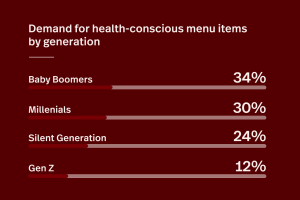
This all runs counter to the common assumption that wellness is primarily a youth movement and goes to show that maybe our grandparent’s cooking wasn’t as unhealthy as it seemed.*
*It probably was, but times, like the Silent Generation themselves, change.
But don’t let the data tarnish the reputation of Generation Z.
The rise of the so-called “soft life” movement offers light at the end of the tunnel for our youthful kin.
Popularised through social media, the soft life rejects hustle culture and constant optimisation in favour of balance, wellbeing and experiences that support a better quality of life.
This could be seen as a reaction to a myriad of other socioeconomic factors, but it’s a step in the right direction, so we’re claiming it here.
And hospitality sits directly at the centre of that conversation. People still want memorable meals, nights out and social experiences, but they’re beginning to ask themselves what those experiences contribute to their lives and is it all worth it when the dust settles and we look across the dining room to see an octogenarian tearing into ethically-sourced steak and washing it down with a crispy Heaps Normal.
I think it is.
Why is demand for bottomless drinks declining?
According to Lightspeed Reports, demand for bottomless drinks has fallen from 22% in 2024 to 17% in 2026, suggesting Australians are becoming more selective about how and why they consume alcohol.
A few years ago, bottomless drinks felt unstoppable. Do you remember that?
For hospitality operators, it was a near-perfect format. Customers loved the value proposition. Venues loved the predictable spend. Social media loved photographing endless mimosas beside stacks of pancakes.
It was a trifecta of wins. The holy trinity of trending.
But according to the Lightspeed State of the Hospitality Industry Report 2026, customer demand for bottomless drinks is now in its 3rd year of consecutive decline, falling from 22% in 2024, to 21% in 2025 and down to 17% in 2026.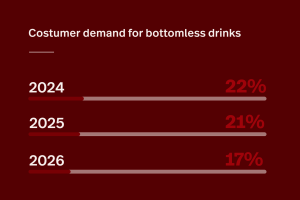
Now I know what you’re thinking. We stopped drinking? Did you see the lines for Two Up this year?
What appears to be happening is a shift away from excess as a selling point.
The rise of mindful drinking, alcohol-free alternatives and wellness-focused social experiences suggests many consumers are becoming more deliberate about when they drink and how much.
It’s all in the balance and you can see this shift playing out across the industry.
Alcohol-free beers have moved from novelty status, scoffed at by the seasoned pokie bandit, to permanent pub fixtures. Venues are investing more heavily in sophisticated non-alcoholic cocktails. Events built around wellness, fitness and recovery are attracting crowds that once might have gathered at their local to sink schooners and shout at athletes on the television.
Even operators are recognising this duality. While 37% plan to offer bottomless drinks in 2026, 36% also plan to expand alcohol-free beverage options.
In other words, we’re learning to cater to both drinkers and non-drinkers at the same time.
Why are venues struggling to keep pace with customer demand?
It’s because operators are still largely focused on different menu trends.
According to the Lightspeed State of the Hospitality Industry Report 2026, the disconnect is striking.
While customers are deep into their wellness eras, operator’s top priority is fusion food with 46% saying they plan to offer it in 2026 and 37% indicating that bottomless drinks are still the way to go.
To be fair, this mismatch is understandable.
Hospitality operators spend their days navigating rising costs, staffing challenges and changing customer expectations. It often feels safer to pursue visible trends than perceive broader cultural shifts.
Plus, fusion food is fun. It lends a certain ¿Por qué no los dos? to menu writing.
Health and wellness, by comparison, can feel harder to define, but that’s exactly why the opportunity exists.
Take Heaps Normal Health Club in Sydney’s Marrickville.
Opened by one of Australia’s most recognisable non-alcoholic beer brands, the venue isn’t any of the things you would normally (Heaps Normally?) associate with a health club. In fact, the team at Heaps Normal are redefining how we approach health, acknowledging that our mental state matters just as much as our physical state. The Heaps Normal Health Club is a dance hall, a live music venue and a bar. Its mission, according to the team, is to rethink what wellness means by focusing on connection, creativity and play.
Early signs of adaptation are already emerging. In fact, 36% of operators say they plan to offer alcohol-free beverages in 2026, acknowledging that today’s customers increasingly want options that align with their lifestyle choices.
And it’s these venues that recognise these opportunities early that may find themselves better positioned as consumer expectations continue to evolve.
What does this all mean for hospitality operators?
For operators, the venues that recognise the correlation between wellness and their clientele’s self-image aspirations will find themselves better positioned to take advantage as these factors evolve.
What would this look like in practice? Glad you asked:
- Expanding high-protein or health-conscious menu options
- Highlighting local and seasonal sourcing more prominently
- Investing in thoughtful alcohol-free beverage programs
- Designing experiences around community and connection
- Creating menus that help customers make intentional choices
Importantly, none of this requires abandoning indulgence.
Burgers still taste better than salads, cocktails still make you feel fancy, and desserts and celebrations will still blind you to the post-calorie lows of a morning after guilt spiral.
The difference is that they’re becoming more selective about when, where and why they indulge, so why not facilitate their wellness binge?
Go beyond the headline stats.
Explore how Australians are eating, drinking and socialising in 2026, and what it means for hospitality operators. Download the full report for free.
Hospitality trend cheat sheet
What do Australian diners want most on menus in 2026?
According to the Lightspeed State of the Hospitality Industry Report 2026, health-conscious food ranks as the most requested menu feature, with 29% of customers wanting to see options such as high-protein or low-sugar dishes. Sustainable food sourcing follows closely behind at 28%, while functional foods rank third at 24%.
Is demand for bottomless drinks declining?
Yes. Demand for bottomless drinks has fallen for three consecutive years, dropping from 22% in 2024 to 21% in 2025 and 17% in 2026. While it remains popular with some demographics, the overall trend points towards more intentional drinking habits.
What generations are driving the wellness movement?
Contrary to popular belief, wellness isn’t being led by Gen Z. Demand for health-conscious food is highest among Baby Boomers (34%), followed by Millennials (30%), Generation X (28%), the Silent Generation (24%) and Generation Z (12%).
Is sustainability still important to diners?
Absolutely. Sustainable food sourcing has ranked among the top two customer priorities for three consecutive years. In 2026, 28% of customers identified local and seasonal sourcing as one of the most important menu considerations when choosing where to eat.
Are venues responding to these changing preferences?
Not entirely. Customers rank health-conscious food (#1), sustainable sourcing (#2) and wellness food (#3) as their top priorities. Operators, however, are focusing on fusion food (46%), bottomless drinks (37%) and alcohol-free beverages (36%), suggesting customer values may be shifting faster than menus are adapting.
What menu trend are operators betting on most heavily?
Fusion food is the most common planned menu addition for 2026, with 46% of operators planning to introduce fusion dishes. However, only 11% of customers say fusion food is a top priority when deciding where to dine.
What is the biggest hospitality trend of 2026?
The data points towards a broader shift from indulgence-led dining to purpose-led dining. Health-conscious food (29%), sustainable sourcing (28%), functional foods (24%) and wellness foods (19%) all rank above traditional trend-led concepts, suggesting Australians increasingly want hospitality experiences that align with their lifestyle values.

News you care about. Tips you can use.
Everything your business needs to grow, delivered straight to your inbox.