
Every restaurateur knows that a menu is one of their most important sales tools. With menu trends drawing customers in now more than ever, it’s extremely important to engineer yours to boost your bottom line.
With limited attention spans and a the ever-increasing impact of technology, it’s still important to give your guests exactly what they want (and need) from a phyiscal menu.
To do that, there are some menu engineering tricks and analysis you can do to inform the decisions you make for both eat-in and delivery menus. Lets dive into how you can elevate your menu.
Make use of our free menu designs
Download your free customisable restaurant menu template today. Tweak it, change colours, add menu items, and adjust costs. It's that simple.
Make use of our free menu designs
Download your free customisable restaurant menu template today. Tweak it, change colours, add menu items, and adjust costs. It's that simple.
What is menu engineering?
Menu engineering is a way to evaluate a restaurant’s menu pricing by using sales data and food costs to guide which dishes to feature and their price. Equipped with that data, menu engineering involves categorising menu items based on their popularity (sales volume) and profitability.
To properly engineer a menu, you need to have a firm grasp of each menu item’s prices, food costs per serving, and contribution margin. With that, you can categorise menu items and see which items contribute more profit and which aren’t pulling their weight. Then, they might need to be updated or removed from the menu altogether.
In a nutshell: menu engineering is a series of exercises that assures each dish and drink featured on your restaurant’s menu is profitable, popular, or both.
What’s the primary goal of menu engineering?
The primary goal of menu engineering is to maximise a restaurant’s profitability by strategically analysing and optimising the menu using specific tactics. Menu engineering involves identifying high-profit and popular items, adjusting pricing, and strategically placing dishes to influence customer choices. By understanding the cost and revenue of each item, and customer behaviour, menu engineering aims to increase overall sales and enhance the dining experience.
What are the benefits of menu engineering?
Menu engineering offers several significant benefits to restaurants that go beyond just designing an attractive menu.
Maximise profitability
Menu engineering can help restaurants maximise profitability by identifying high-margin and popular dishes. By strategically positioning those dishes on a menu and using eye-catching descriptions and visuals, customers are more likely to be enticed to order them, increasing overall sales and revenue.
Cost management
Menu engineering pushes restaurants to take a closer look at their costs by analysing the cost of ingredients and preparation for each dish. Restaurants can identify dishes with high food costs and low profit margins, then either adjust their pricing, rework the recipe to improve profitability, or remove altogether.
Improved customer experience
By showcasing popular dishes prominently and ensuring clear and appealing descriptions, customers can make choices more easily and enjoy their meal without feeling overwhelmed or confused by the menu options.
Reduction of food waste
With a well-engineered menu, restaurants can plan ingredient quantities more accurately, leading to fewer unsold perishable items and ultimately minimising waste.
Innovation
Menu engineering can also encourage innovation and seasonal menu updates. Regular analysis of menu performance allows restaurants to experiment with new dishes and update their offerings to match changing customer preferences, keeping the menu fresh and exciting.
Drawbacks to menu engineering
While menu engineering is ultimately a positive process for any restaurant, it can come with drawbacks when it’s not done properly. Focusing solely on profit might neglect customer satisfaction and menu variety. It might also hinder creativity and experimentation. How often you edit your menu is also something to consider. While changing the menu seasonally could bring excitement and innovation into the mix, changing the menu weekly could create confusion for customers. To succeed, it’s best to strike a balance between profitability and customer experience, periodically reviewing the menu and considering customer feedback.
How to engineer a menu and maximise profits
While the time it takes will vary based on the size of your menu offering, menu engineering can be broken down into five broad steps.
- Choose a time period
- Cost your menu
- Categorise menu items based on profit and popularity
- Redesign your menu
- Measure your new menu’s impact
1. Choose a time period
First thing’s first, you need to select a time period to analyse. If you switch up your menu based on the seasonality of produce, it makes sense to do this when you’re crafting new seasonal menu items. If you rarely make adjustments to your menu, you can revisit your menu less frequently.
Don’t make the mistake of never revisiting your menu pricing, though. Food costs fluctuate and your menu prices need to reflect that. If your food costs grow while your menu price stays the same, your gross profit margin shrinks, and you make less money on the sale.
2. Cost your menu
The metrics you need to measure menu item profitability are food cost percentage and contribution margin.
That information should be readily available in your restaurant ePOS system, but if it isn’t, you can calculate manually using the following formulas.
How to calculate food cost per serving
To find your food cost per serving, you need to list the ingredients used to make a dish, how much of the ingredient you use, and how much each costs. Include everything down to the seasoning and garnishes.

Here’s a look at calculating food cost per serving in action.
Let’s say you’re a fast food trader in the U.K., and you pay £19 for five pounds of ground beef. It takes you 8 ounces of beef to make a single burger, which brings the cost of ground beef per serving to £1.90.
Perform that same exercise for each ingredient and you get something like this:
- 8 ounces of ground beef = £1.90
- 1 sesame seed bun = £0.25
- 1 tbsp. of sauce = £0.10
- 2 slices of cheeses = £0.90
- 2 slices of tomatoes = £0.50
Add the values for each ingredient used to make one burger and you get a food cost per serving of £3.65.
How to calculate contribution margin
Your contribution margin (or the profit from that individual menu item) is the difference between an item’s selling price and its cost.

Let’s say your hamburger’s menu cost is £14.40 and your food cost per serving is £3.65.
Contribution margin = £14.40 – £3.65
Subtract the £3.65 food cost per serving from the £14.40 menu cost and you get a contribution margin of £10.75.
Using analytics to determine menu item popularity
Understanding your menu’s performance using data fed by your point of sale will give you an edge when updating your menu. Most ePOS systems have reports that show how much you sold of a menu item over a period of time. Getting actionable insights is key when redesigning your menu and understanding what works and what doesn’t. With Lightspeed’s Advanced Insights, you can take a deeper look at customer behaviour with unique guest profiles and order tracking. This gives you access to how much specific customers spend and which items they order most. You also get access to a detailed breakdown of your menu performance, with insights on best and worst performers.
Along with concrete data, sit down with your servers and bartenders and hear from them. Are there certain dishes they sell often? They’re on the front line talking with customers every shift and can give valuable insight. With clear data to back up your decisions, share insights with your employees and come up with a plan to move forward.
Create your menu in minutes
You don’t need to be a designer (or hire one) to create a beautiful menu. Download your free, easily-customisable menu templates today.
3. Categorise menu items based on profit and popularity
Once you know how much of each menu item you sold over a certain period of time and its contribution margin, you can categorise each one based on popularity and profitability in a menu matrix.
Menu items will fall into one of four menu engineering categories: plowhorses, stars, duds, or puzzles. Once completed, a menu matrix gives you a clear understanding of which menu items are responsible for your profits, which aren’t, and which ones need to be reworked or removed from your menu altogether.
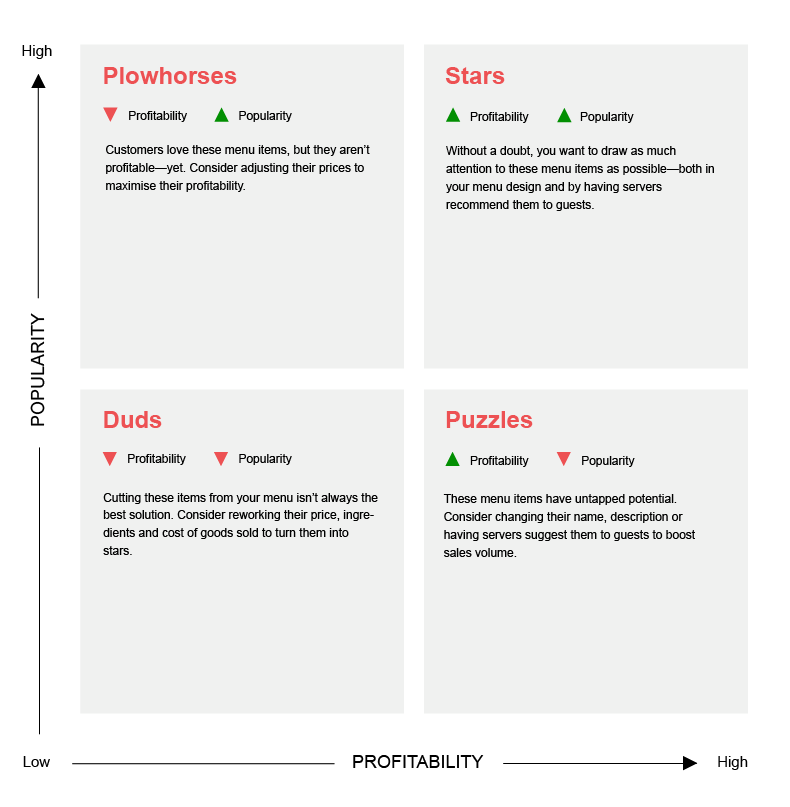
Plowhorses: Low profitability, high popularity
Plowhorses are popular menu items with food costs that are more expensive. The objective with menu items that fall into this category is to make them more profitable either by raising their menu price, lowering food costs, reworking the recipe with different ingredients, or pairing them with high-profit sides and cocktails.
Also, pay attention to the portion size of your plowhorses. If you’re noticing that customers rarely finish their plate, it may be wise to serve slightly smaller portions, reducing food waste and food cost per serving in the process.
Stars: High profitability, high popularity
Stars are your menu’s most popular, profitable items. They’re inexpensive to make and your guests order them often. Rather than rework these menu items, it’s best to leave them as they are and promote them in any way you can.
Make sure your menu design draws special attention to them, increasing the likelihood that you sell more of your stars and maximise profits per service.
Puzzles: High profitability, low popularity
Puzzles are menu items that are profitable, but not a popular choice. Try to pinpoint why they aren’t selling. Are they noticeable on your menu? Could they benefit from a more compelling description? Should you promote the dish on Instagram? Is the menu price too high?
Any of these can have an effect on a menu item’s popularity. Try experimenting with them and measuring the results of the changes you make on their sales.
Duds: Low profitability, low popularity
Duds are the menu items that are expensive to make and aren’t popular. They take up valuable space on your restaurant menu, and distract your guests from your stars and puzzles.
You have several options for what to do with duds. You can remove them from your menu entirely, de-emphasising them or reworking the price or ingredients based on customer feedback. If you choose to rework a dud and both its sales and contribution margin remain low, consider removing it from the menu altogether.
4. Redesign your menu
Now, it’s time to use your menu matrix to rethink which dishes to include in your new menu design and layout.
Along with the quantitative data, it’s also important to gather qualitative data and feedback from your servers and customers.
Ask your servers which dishes they typically sell the most, which ones they have a hard time selling, and which dishes get negative feedback from guests. Consider sending a Typeform survey to your customers or members of your loyalty program. What do they love about your restaurant? What would they like to see improve? Which dishes are their favourite and least favourite? Do they think there are enough options?
The only way to know is to ask. Use both the quantitative data from your menu matrix and the anecdotal information from your surveys and conversations with staff to further inform which menu items make the final cut for your re-engineered menu.
Here are some things to keep in mind as you redesign your menu:
What is menu psychology?
Menu psychology focuses on how patrons interact with menus and how menus can be designed to motivate customers to take a specific action (like ordering more and spending more). Everything from the number of items in the menu to the colours and placement is analysed in menu psychology.
Why should restaurants leverage menu psychology?
Restaurants should leverage menu psychology because it can be a tool to enhance the overall dining experience and boost profitability. By understanding the psychological factors that drive decision-making, such as colour, layout, pricing, and item placement, restaurants can optimise their menus to encourage higher spending, increase customer satisfaction and drive repeat business. Descriptive language and tantalising imagery can make dishes more appealing, while grouping high-profit items strategically can increase their chances of being ordered. Highlighting popular or signature dishes can also create a sense of social proof and encourage customers to try those items.
Choose the ideal menu configuration
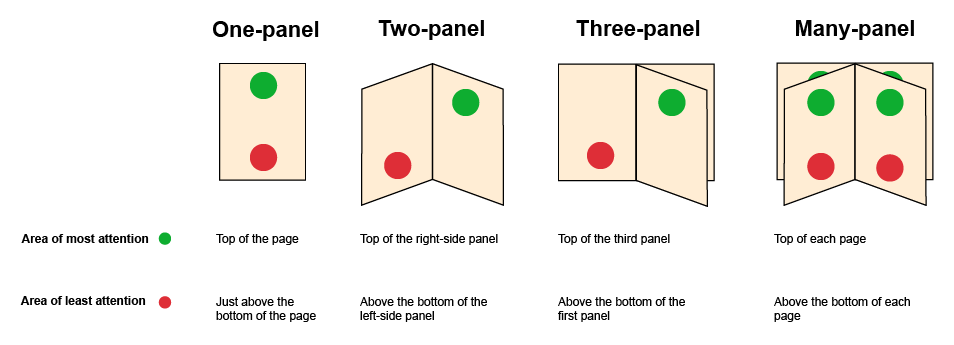
Not all menu configurations are created equal. According to Gregg Rapp’s menu engineering methodology, the effectiveness of your menu engineering efforts is dependent on how many panels your menu has.
- One-panel menus: Although customers make decisions faster with one-panel menus, they don’t order as much, which results in lower profits per customer.
- Two-panel menus: This is the best menu configuration according to Rapp. It evokes the feeling of a full dining experience while being easy for customers to read.
- Three-panel menus: If you have a lot of menu items and need the space, a three-panel menu is a good option. However, two-panel menus can be easier for guests to read.
- Many-panel menus: The more panels your menu has, the less control and influence you have over the decisions customers make.
Emphasise your stars and puzzles
Place eye magnets (graphic elements like an outline, icon, photo or splash of colour) next to the menu items you want to sell the most. That graphic element will draw customers’ eyes and have them focus their attention on the menu items you want them to try.
Just don’t overdo it with those graphics. If you use too many, each of the highlighted items won’t stand out. Rapp says that featuring just one graphic element per page can increase sales of that menu item by as much as 30%, but the more visual cues you add, the lower the impact.
When using eye magnets to draw attention to your stars and puzzles, remember that less is more.
Consider eye movement patterns
People’s eyes tend to focus on certain areas of a menu depending on whether it’s a one-panel, two-panel, three-panel or many-panel menu. Rapp suggests placing the dishes you want to draw attention to in the areas where people’s eyes tend to focus on.
Beware of the burden of choice
When confronted with too many options, customers have a harder time deciding what they want and are more likely to be unsatisfied with the choice they end up making. But good news: preventing customers from feeling FOMO (the fear of missing out) is possible.
If you have an extensive menu that includes your breakfast/brunch and dinner options, it may be wise to split that into several different menus, swapping them in and out as one service begins and the other ends.
If the issue is that you have a large selection, consider refining your menu. Cost each menu item and see if there are any duds that you can remove from your offering altogether.
Train your staff
When we think of menu engineering, we often think about the behind-the-scenes strategy that goes into crafting a restaurant menu. But a restaurant’s staff also has the power to influence what guests buy.
They’re the ones interacting with guests each day. Teach them which menu items to push and they can help guide customers towards choosing those profitable dishes.
5. Measure your new menu’s impact
Once you’ve finished your menu redesign and it’s been live for a month or so, look at your sales data to see if the tweaks you made have had a financial impact. Did you sell more of your puzzles and stars? Did you net more profits that month than in previous months? Were your food costs lower?
Depending on what you find, you could continue tweaking old dishes, testing new dishes, and rethinking your layout. The funny thing about restaurant menus is that there’s always room for improvement.
As you test, track your results so you know what worked and what didn’t.
With Lightspeed Advanced Insights you can look even deeper at your menu performance. With its comprehensive data analytics tools, you can easily track and analyse key performance indicators related to your menu, like sales trends, item popularity, and profitability.
By understanding which dishes drive the most revenue and garner the highest customer interest, restaurant owners and managers can make data-driven decisions to optimise menus for greater profitability and customer satisfaction. This data-driven approach empowers restaurants to identify strengths, weaknesses, and opportunities within their menu offerings, ultimately leading to a more successful and engaging dining experience for customers.
With Lightspeed Restaurant, Julien Samson, the Operating Officer for Arakel, uses data to stay on top of what is and isn’t successful on his menu. “I regularly check the sales statistics, especially during menu launches: it allows me to track best-sellers and quickly adjust what doesn’t work.”
The science behind a profitable menu
Menu engineering can feel like a daunting task, but it doesn’t have to be. Select a timeframe, cost your menu, categorise each dish based on its popularity and profitability, redesign your layout (either by hiring a designer or using our handy menu templates), and measure the impact of the changes you make.
By following these steps and building a menu the right way, you’re setting each eat-in, takeaway, or delivery order up to be a profitable one.
Looking for data and insights to back up your menu revamp? Talk to one of our experts to find out how Lightspeed can help.

News you care about. Tips you can use.
Everything your business needs to grow, delivered straight to your inbox.