- New research reveals the generational divide between younger and older diners when it comes to tipping and paying service charge
- 33% of 18-29s are happy to pay service charge, while one in five over 60s say it should never be paid
- To paint a portrait of the nation’s tippers, Lightspeed has teamed up with behavioural psychologist Jo Hemmings to create five tipping types that most of us fall into
LONDON, February 23, 2026: Lightspeed Commerce Inc. (NYSE: LSPD) (TSX: LSPD) (“Lightspeed” or the “Company“: Brits may grumble about paying a tip or service charge when dining out, but new research from Lightspeed shows that when the bill lands, most of us still keep quiet and cough up.
Nearly half (46%) of the nation feels annoyed or pressured when service charge is added yet 47% will always pay it, revealing how the UK doesn’t put its money where its mouth is. What’s more, while 80% understand the difference between a tip and service charge, over a third (37%) think that tipping when a service charge is included in the bill is pointless.
The contradictions don’t stop there, and there’s a clear generation gap being observed at the dinner table.
Young Brits pay up while older diners push back
Younger diners (18-29) are far more relaxed about service charges, often seeing them as a way to support an industry under pressure. More than one in three say they’re happy to pay service charge, compared to fewer than one in five over-45s.
26% of 18-29s say service charge should always be paid to support hospitality, more than double the rate of Gen X (11%). By contrast, older diners are having none of it, with one in five over-60s believing that a service charge should never be paid.
Jo Hemmings, Behavioural Psychologist, explains how the generational divide around tipping and service charge is often a result of the different economic environments people were brought up in:“Much of the younger generation grew up during rising living costs so to them, economic pressure can often feel normal. As a result, many view service charge as a way to support the hospitality industry, often because they themselves have worked in it.”
“Older generations have been shaped by different economic conditions, and can sometimes see additional costs as the restaurant’s responsibility. Even though it’s optional, seeing a service charge printed on the bill can make older diners feel like their choice has been taken away, while younger adults often see paying service charge as a way to show solidarity.”
When it comes to tipping, those aged 60+ are quick to tighten the purse strings if their experience was anything short of immaculate. In fact, 38% feel that restaurants deciding the tip amount for them is manipulative and takes their choice away, compared to just 17% of 18-29 year olds.
Even though 72% of Brits always look through the bill to ensure they’re being charged the correct amount, it’s the over-60s that are the most eagle eyed (62%). When they do tip, 75% do it as a genuine thank you while 38% of 18-29s see it as a moral obligation and a way to avoid feeling awkward.
Britain’s breaking point
Despite the grin and bear it approach, there are times when politeness goes out of the window. Most diners agree it’s acceptable to remove service charge if the food is bad (61%), the waiter is rude (61%) or if service is slow (55%).
However, it’s clear that older diners are more likely to take action, while younger customers often pay even when they’re not convinced it’s deserved.
Although a bad dining experience can leave Brits feeling deflated, over half (52%) of us think our mood before we enter the restaurant also affects our generosity. On average, Brits are likely to tip 8.7% less if they are already annoyed about something before sitting down at the table. This rises slightly to 8.9% for 18-29 year olds, while 30% of those 60+ say their mood doesn’t affect their tipping behaviour in the first place.
Jo added: “As we get older, our emotions tend to stabilise and we form fixed habits when it comes to financial and social decisions. Tipping becomes routine with age and experience rather than something that’s emotionally driven, meaning mood plays a much smaller role in shaping behaviour among older adults.”
Is Britain taking inspiration from across the pond?
While tipping and paying service charge is optional in the UK, 61% of Brits think it’s becoming more expected like in the US and 34% don’t like that. This rises to 40% for over-60s, while only 25% of 18-29 year olds are fazed.
Liam Crooks, Managing Director of EMEA Hospitality at Lightspeed, said: “Tipping continues to be very much up for debate amongst Britain’s diners. Factors like rude service, unpleasant food or even our age can play a big role in how we’re willing to reward a restaurant experience. While there’s never going to be one standard blueprint of a British diner, it’s interesting to see how different factors shape the types of tippers we all are.”
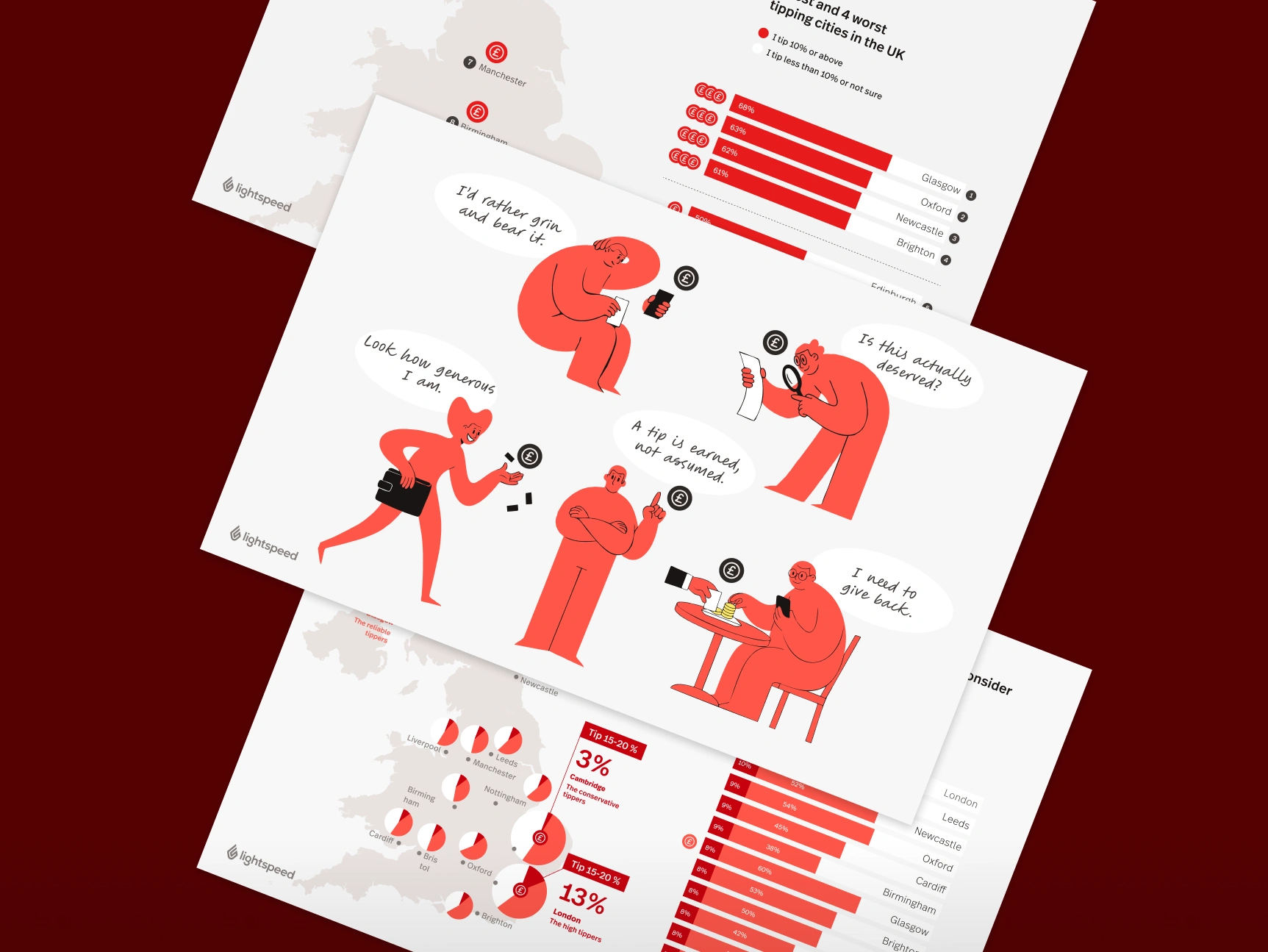
To help the nation find out more about their tipping habits, Jo helped Lightspeed create the five personas most of us fall into when dining out:
Britain’s Tipping Types
The Goodwill Giver
Tips: Empathetically and generously.
Why: Understands the pressures facing the hospitality industry and wants to support it. Their tip says, “It’s tough out there and I want to help.” They’re more likely to understand that there is a clear distinction between the service charge vs tip (voluntary act of kindness vs costs). To them, paying service charge and tipping is an act of collective responsibility.
Thinks: “I need to give back.”
The Silent Sigher
Tips: To avoid awkwardness – even if they don’t like it.
Why: Wants to avoid conflict, but feels as though there are certain social norms they need to abide by. Their tip says, “Sometimes I don’t agree with this charge, but I’ll still pay it.” If they’ve had a bad experience or they feel that the service charge is too expensive, they’re likely to feel annoyed but still pay without raising concerns. To them, the act of tipping is a way to keep the peace.
Thinks: “I’d rather grin and bear it.”
The Tip Traditionalist
Tips: Modestly and occasionally.
Why: This diner doesn’t believe that tipping or service charge should be automatic. They aren’t afraid to speak up if their expectations aren’t met, believing that a tip is a way to show a genuine thank you rather than a moral obligation. Their tip says, “I’m in control and it’s my choice.”
Thinks: “A tip is earned, not assumed.”
The Service Skeptic
Tips: Cautiously and rationally.
Why: Driven by both value for money and a consistent experience, this diner will meticulously check the bill and ensure their expectations are met before paying anything extra. They may remove the service and leave a tip instead to show their gratitude to their waiter directly. Their tip says, “My experience was worth it.”
Thinks: “Is this actually deserved?”
The Social Performer
Tips: Generously and conspicuously.
Why: This diner tips as a form of identity management. Their tip says, “I’m good, I’m successful, and I see you.” They’re highly attuned to how they’re perceived by their dining companions and staff alike. To them, the act of tipping is as important as the amount – sometimes even more so.
Thinks: “Look how generous I am.”
To read more about Britain’s tipping types, visit: https://www.lightspeedhq.com/uk/tipping/
ENDS.
Methodology
- Lightspeed initiated a consumer survey in January 2026 using third party survey vendor Perspectus Global. 2,023 responses were collected across the UK. Respondents were required to be over the age of 18, all responses collected were anonymous, and have been quality reviewed for a reasonable margin of error.
About Lightspeed
Lightspeed is the ePOS and payments platform powering businesses at the heart of communities in over 100 countries. As the partner of choice for ambitious retail, golf and hospitality entrepreneurs, Lightspeed helps businesses accelerate growth, deliver exceptional customer experiences, and run smarter across all channels and locations.
With fast, flexible omnichannel technology, Lightspeed brings together point of sale, ecommerce, embedded payments, inventory, reporting, staff and supplier management, financial services, and an exclusive wholesale retail network. Backed by insights, and expert support, Lightspeed helps businesses run more efficiently and focus on what they do best.
Founded in Montréal, Canada in 2005, Lightspeed is dual-listed on the New York Stock Exchange and Toronto Stock Exchange (NYSE: LSPD) (TSX: LSPD), with teams across North America, Europe, and Asia Pacific.
For more information, see www.lightspeedhq.co.uk.
Follow us on social media: LinkedIn, Facebook, Instagram, YouTube, and X.
Forward-Looking Statements
This news release may include forward-looking information and forward-looking statements within the meaning of applicable securities laws (“forward-looking statements“). Forward-looking statements are statements that are predictive in nature, depend upon or refer to future events or conditions and are identified by words such as “will”, “expects”, “anticipates”, “intends”, “plans”, “believes”, “estimates” or similar expressions concerning matters that are not historical facts. Such statements are based on current expectations of Lightspeed’s management and inherently involve numerous risks and uncertainties, known and unknown, including economic factors. A number of risks, uncertainties and other factors may cause actual results to differ materially from the forward-looking statements contained in this news release, including, among other factors, those risk factors identified in our most recent Management’s Discussion and Analysis of Financial Condition and Results of Operations, under “Risk Factors” in our most recent Annual Information Form, and in our other filings with the Canadian securities regulatory authorities and the U.S. Securities and Exchange Commission, all of which are available under our profiles on SEDAR+ at www.sedarplus.com and on EDGAR at www.sec.gov. Readers are cautioned to consider these and other factors carefully when making decisions with respect to Lightspeed’s subordinate voting shares and not to place undue reliance on forward-looking statements. Forward-looking statements contained in this news release are not guarantees of future performance and, while forward-looking statements are based on certain assumptions that Lightspeed considers reasonable, actual events and results could differ materially from those expressed or implied by forward-looking statements made by Lightspeed. Except as may be expressly required by applicable law, Lightspeed does not undertake any obligation to update publicly or revise any such forward-looking statements, whether as a result of new information, future events or otherwise.